



Effective coaching isn’t measured by the quality of the conversation alone. It’s measured by what people are able to do differently afterwards.
As leaders, it can be tempting to measure our coaching by what happens in the moment.
- Did I ask good questions?
- Did I listen rather than jump in with the answer?
- Did we have a useful conversation?
- Did the person leave with greater clarity?
These things matter. But they are only part of the picture.
The real test of coaching is what happens after the conversation.
Are people thinking more independently? Are they making decisions with greater confidence? Are they taking more ownership? And are they increasingly able to find their own way forward when things become difficult?
Because ultimately, coaching isn’t about becoming better at answering people’s questions.
It’s about helping people become better at answering their own.
From problems to possibilities
One of the most visible shifts happens in the way people bring challenges to you.
Instead of:
“Here’s the problem. What should I do?”
you begin to hear:
“Here’s the challenge. I’ve thought about a few options and this is what I think we should do.”
That is a significant difference.
Effective coaching helps people think through challenges, explore possibilities, use their judgement and develop their own ideas and solutions.
And over time, there are some practical signs that this shift is happening.
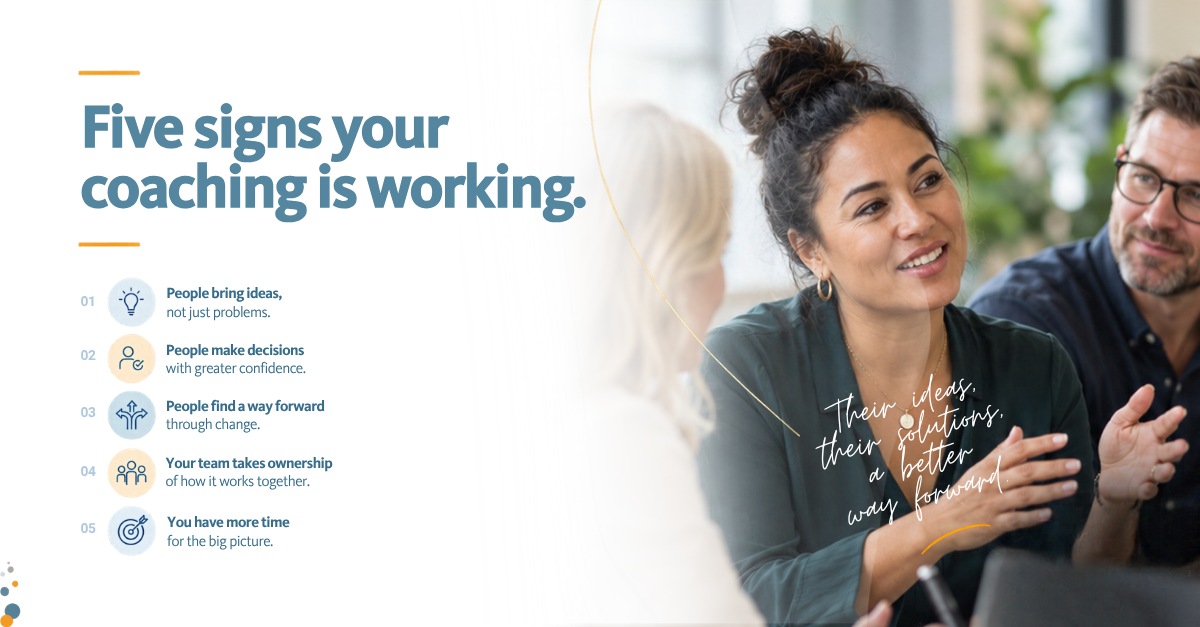
Here are five signs your coaching is working:
1. People bring ideas, not just problems
When people immediately bring every problem to their leader, it is very easy for the leader to become the problem-solver.
Often that’s quicker. You know the context. You may have dealt with something similar before. You can probably provide an answer in a few minutes.
But repeatedly providing the solution can unintentionally reinforce the idea that you are the person who has the answers.
Coaching changes that dynamic.
Instead of automatically solving the problem, you help people think it through: What is really happening? What options have they considered? What could they try? What do they recommend?
Over time, people begin doing more of that thinking before they come to you.
They don’t stop bringing challenges. They start bringing thinking alongside them.
2. People make decisions with greater confidence
Good coaching also builds judgement.
People become clearer about where they have authority to act, more comfortable weighing up options and more confident making decisions without continually seeking approval.
That doesn’t mean people stop asking for support.
It means the nature of the conversation changes.
Rather than:
“Can you tell me what to do?”
it becomes:
“This is what I’m proposing and here’s why.”
For leaders, that is an important indicator of growing capability.
3. People find a way forward through change
Change can create uncertainty, frustration and sometimes resistance.
A coaching approach doesn’t mean ignoring those reactions or trying to persuade people that everything will be fine.
Instead, it creates space to explore them.
- What is concerning you?
- What can you influence?
- What do you need?
- What possibilities can you see?
- What is the next step you can take?
The leader’s role isn’t necessarily to remove every obstacle or provide every answer.
Sometimes the most valuable thing we can do is help someone move from feeling stuck by the situation to seeing where they still have choice and agency.
4. Your team takes ownership of how it works together
Coaching isn’t only a one-to-one leadership capability.
It can also change the way a team operates.
High-performing teams don’t rely solely on their leader to manage every relationship, resolve every tension or maintain accountability.
People begin to take greater responsibility for the team’s collective performance.
They have the conversations that need to happen. They clarify expectations. They address issues. They support and challenge one another. And they become more deliberate about how they work together, not simply what they deliver.
That shift from leader-owned to shared ownership can be incredibly powerful.
5. You have more time for the big picture
There is also an important consequence for the leader.
If every problem, decision and challenge eventually finds its way back to you, your capacity becomes the team’s capacity.
You become the bottleneck.
But as people’s confidence, judgement and capability grow, they need you differently.
You can spend less time resolving everyday issues and more time looking ahead, thinking strategically, connecting across the organisation and focusing on the work that genuinely requires your leadership.
That’s not stepping away from your people.
It’s evidence that you’ve helped them grow.
So, what is your coaching really changing?
Knowing coaching frameworks and asking good questions is a great start.
But the goal isn’t simply to become a leader who coaches well.
The goal is to build more capable, confident people who can think, decide and act for themselves — and teams that increasingly take ownership of their collective success.
So perhaps the most useful question isn’t:
“Am I coaching enough?”
It’s:
“What are my people taking ownership of now that they weren’t before?”
The answer tells you a great deal about the impact your coaching is having.
Continuing the conversation
Over the coming weeks, we’ll be exploring coaching from several different perspectives — including Coaching for Change, Team Performance and Growth.
We’ll look at how leaders can use coaching not simply as a framework or a scheduled conversation, but as a practical leadership capability that helps people navigate challenges, build confidence and achieve better outcomes.
Because the best coaching doesn’t create greater dependence on the leader, it creates greater capability in others.
Their ideas. Their solutions. A better way forward.
Build coaching capability that makes a difference
At Mather Consulting, we work with leaders and teams to develop practical coaching skills that build confidence, strengthen capability and encourage greater ownership.
If you’re looking to embed coaching into your leadership approach or develop coaching capability across your organisation, we’d love to help.
Get in touch to explore how we can support you and your team.
For more insights, updates and news from Mather Consulting, follow us on LinkedIn.