



CliftonStrengths®: Turning Leadership Talent into Team Performance
What strengths already exist within your leadership teams — and are you making the most of them?
Gallup CliftonStrengths® can help leaders understand their natural talents and use them more intentionally. But its value can go much further than individual self-awareness.
Used collectively, it can help leadership teams understand the talent already around the table. It can highlight potential gaps and blind spots. And it can help leaders work together with greater intention and impact.
Earlier this year, we worked with a senior leadership team that wanted to lift its collective influence and impact.
The team quickly recognised an opportunity.
They wanted to draw on each other’s strengths in a more deliberate and targeted way.
The challenge?
They didn’t yet have a shared understanding of the natural talents within the team. Nor could they clearly see where they might have collective gaps or blind spots.
This is where CliftonStrengths came into play.
What is CliftonStrengths?
For more than five decades, Gallup has studied the ways successful people think, feel and behave. This research led to the development of the CliftonStrengths assessment.
The assessment identifies the talent themes that come most naturally to you.
These are your instinctive patterns of thinking, feeling and behaving.
When those talents are understood and intentionally developed, they can become powerful strengths.
For leaders, this creates an opportunity to understand not only what they do well, but why certain ways of leading come more naturally to them.
Why CliftonStrengths matters for leaders
Leadership development can sometimes focus heavily on fixing weaknesses.
A strengths-based approach starts somewhere different.
It asks:
- Where do I have the greatest natural potential?
- How can I use those talents more deliberately?
For leaders, CliftonStrengths can help build greater self-awareness and confidence.
It can help leaders:
- understand how they naturally lead and contribute
- apply their talents more intentionally
- recognise and manage potential blind spots
- partner with people whose strengths complement their own
- focus their development where it can have the greatest impact.
Importantly, this doesn’t mean leaders should only do what comes naturally.
Every leadership role will require people to stretch, adapt and develop.
Instead, the value lies in understanding where your greatest potential exists — and learning how to use it well.
From individual strengths to leadership team performance
This is where the conversation becomes particularly interesting.
Senior leadership teams play a critical role in organisational success.
- They shape strategy.
- They lead through pressure and uncertainty.
- They make complex decisions.
- And ultimately, they need to deliver results together.
Yet leadership teams can easily overlook one of their most valuable assets:
- The combined strengths already around the table.
High-performing leadership teams don’t expect every leader to be equally strong in every area.
Instead, they understand what each person brings.
They intentionally draw on different strengths.
They build complementary partnerships.
And they support one another where gaps exist.
This shifts the conversation from:
“What are my strengths?”
to:
“How can we use our strengths to perform better together?”
Understanding your team’s collective strengths
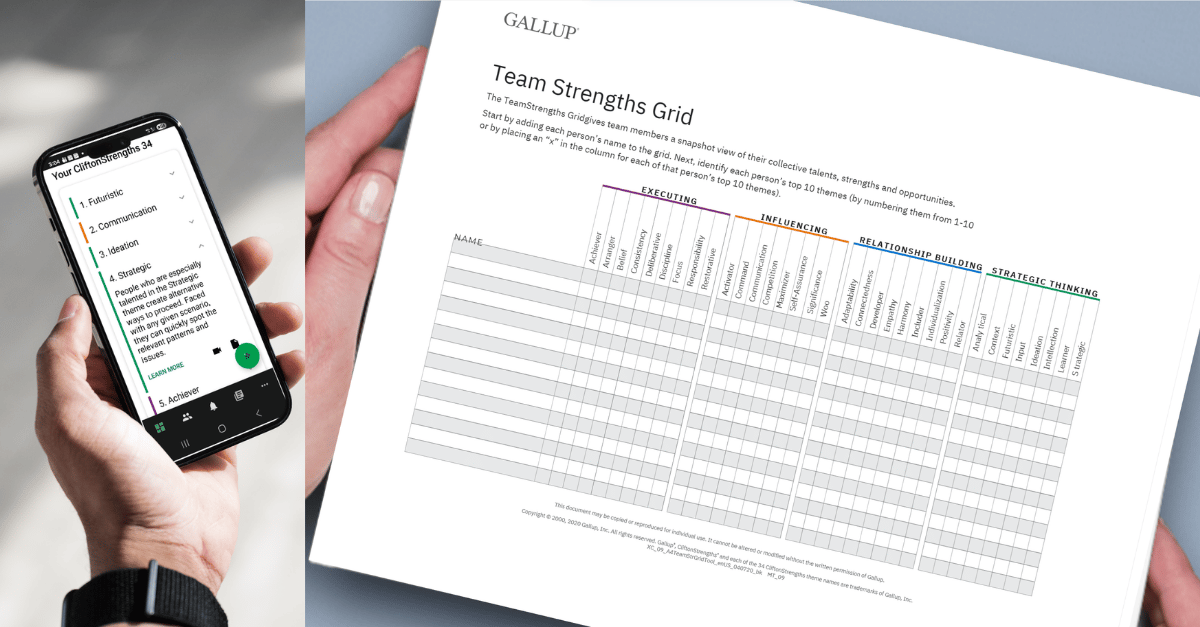
One of the tools available through CliftonStrengths is the Team Grid.
It provides a visual picture of the team’s collective talents across four broad domains:
- Strategic Thinking — how people analyse information and think about possibilities.
- Influencing — how people take charge, speak up and help ideas reach a wider audience.
- Relationship Building — how people create connections and hold teams together.
- Executing — how people turn ideas into action and get things done.
Seeing the team’s talents together can create a very different conversation.
- Where do we have significant strength?
- Where might talent be underused?
- Are there areas where we have fewer natural strengths?
- What could that mean for the way we operate as a leadership team?
- And who should we draw on when different challenges arise?
Strengths can also reveal blind spots
Understanding strengths isn’t simply about celebrating what a team does well.
It can also help surface potential blind spots.
For example, a leadership team may have significant natural talent for generating ideas and thinking strategically.
That’s valuable.
But who ensures those ideas move into action?
Another team may be highly execution-focused.
They know how to deliver.
But are they creating enough space to challenge existing thinking and explore what might be possible?
Neither profile is inherently better.
The value comes from recognising the team’s natural patterns and asking:
What does this mean for the way we lead together?
That awareness gives leaders the opportunity to be more intentional.
From insight to action
Of course, completing an assessment isn’t what creates change.
The real value comes from the conversation that follows.
Used as part of a facilitated leadership team discussion, the CliftonStrengths Team Grid can help leaders:
- appreciate the different contributions within the team
- identify strengths that may be underused
- recognise collective gaps and potential blind spots
- build more effective leadership partnerships
- draw on the right people for different challenges
- work together with greater intention.
It creates a shared language for talking about talent.
More importantly, it gives teams a practical platform for deciding how to use that talent.
What could your leadership team unlock?
Leadership teams already contain a wealth of experience, capability and talent.
The opportunity is to understand it — and then use it deliberately.
CliftonStrengths can help individual leaders better understand themselves.
But when that insight becomes collective, something else becomes possible.
- Leaders can see how their talents complement one another.
- They can recognise where they need support.
- They can draw on different people for different challenges.
- And they can start turning individual strengths into collective performance.
So, perhaps the question for your leadership team is:
Do you really know the strengths you have around the table — and are you making the most of them?
If your leadership team wants to better understand what it naturally does well, where potential gaps may exist and how to leverage its strengths more deliberately, Mather Consulting would love to help you explore what CliftonStrengths could unlock.
For more insights, updates and news from Mather Consulting, follow us on LinkedIn.